
 4 hours ago
1
4 hours ago
1
[By Jeong-yoon Lee, Edaily] “In the future, geopolitical conditions will become a major factor shaping investment decisions by both the private sector and governments. Cross-border capital movements are likely to decline, while capital flows between politically close countries will become more active.”
Thorsten Beck, a world-renowned scholar in productive finance and a professor at the European University Institute (EUI), made this prediction in a recent interview with Edaily. “Global capital flows are increasingly shifting toward the ‘within-bloc’ movements, and this change has already begun,” He stated, “While profitability and efficiency once primarily drove investment decisions, geopolitical factors will now become far more critical factors.”
As the U.S.-China strategic rivalry, supply chain realignments, wars, and widespread sanctions reshape the world, the global financial order is also being rapidly reorganized. Capital is no longer moving solely based on returns and efficiency, but is increasingly being reorganized according to political and security interests. Professor Beck analyzes that finance is moving beyond being a neutral resource allocation tool to become an instrument of national strategy and geopolitical competition.
He will deliver a keynote speech on the second day of the 17th Edaily Strategy Forum, to be held June 16~17 at the Shilla Hotel in Seoul, under the theme: “Power Realignment and Productive Finance: The Role of the Financial System in a Changing Global Order.”
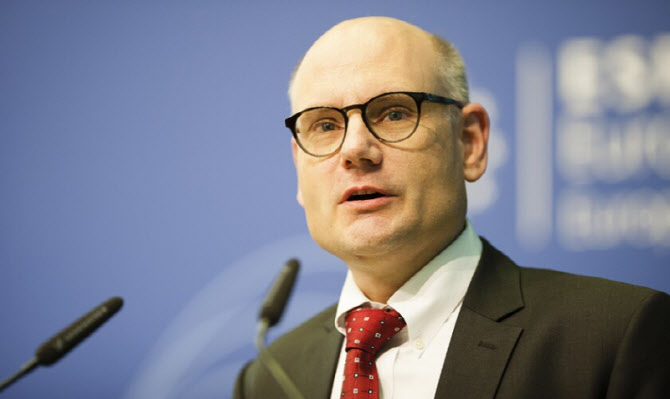 |
| Thorsten Beck Professor of European University Institute, Director of Florence School of Banking and Finance |
‘Geopolitics Over Yields’… A Paradigm Shift in Global Capital Flows
Professor Beck evaluates that the world economy has entered a structural turning point where not only economic cycles but the rules of capital movement are changing. He says both corporations and governments are placing greater importance on “which countries are politically and security-wise close” when making investment decisions.
He predicted, “Cross-border capital flows will decline, while capital movement among politically aligned countries will increase.” he said. “This could lead to a bloc formation similar to the Cold War era. He noted that International Monetary Fund (IMF) research has already identified increasing capital flows among geopolitically aligned nations. ”This trend could lead to the formation of blocs similar to the Cold War era,“ he warned. ”The world is moving toward fragmentation, not just in trade but in finance as well.“
He also forecast a significant rise in hedging demand for overseas investments. ”Risk-avoidance transactions aimed at reducing foreign exchange or geopolitical risks is expected to surge,“ he explained. ”At the same time, the overall scale of cross-border assets and liability volumes may shrink.“
Professor Beck expressed concern that weakening international cooperation could undermine the global community‘s ability to respond effectively to future financial crises. ”During the global financial crisis in 2008, coordination among major economies was relatively smooth, but in today’s fragmented world, a joint response would be much harder to achieve.“
In particular, he highlighted the potential changes of the U.S.-centric international financial system. As the U.S. utilizes the dollar payment network and financial sanctions as tools for diplomacy and security, fragmentation of the global financial system could accelerate.
”International finance has long been used as a sanction tool, but it is now being deployed in far more extensive ways,“ he said. He analyzed that ”Sanctions, taxes, and financial regulations are increasingly being used for geopolitical objectives.“ He continued, ”The more actively the U.S. utilizes the dollar-based settlement system and financial sanctions as instruments of diplomacy and security policy, the greater the pushback against the dollar-centric order may become.“ He predicted that ”This could lead to a division of the monetary system centered around the U.S., Europe, and China.“
”Productive Finance Becomes More Important in the Geopolitical Era“
Professor Beck emphasized that in this environment, the importance of ”productive finance“ is once again growing. Productive finance refers to funding channeled into productive investments in tangible and intangible assets, rather than consumption or real estate transactions.
”Early research on finance and economic growth was originally based on the premise of productive finance,“ he noted. ”In many advanced economies over the past few decades, bank lending has increasingly flowed toward real estate and consumption.“ He explained that productive finance is regaining prominence recently because growth performance in advanced economies, including Europe, has fallen short of expectations since the global financial crisis. ”On top of that, rising geopolitical tensions and intensifying industrial competition have increased the need for long-term investment in strategic industries.“
However, he warned that excessive government intervention in expanding productive finance could lead to capital flowing into less competitiveness sectors or create problems of preferential treatment for certain industries or firms.
”During East Asia‘s period of economic growth, governments played a role in promoting productive finance, and this was successful to a significant extent,“ he noted. ”But maintaining a balance between market discipline and government support is crucial.“ He added that ”rather than the government directly determining all resource allocation, it is preferable for the government to provide directions and institutional frameworks while the private sector makes the actual investment decisions.“
He advised that Korea must move beyond a bank-loan-centered financial structure to expand productive finance. In particular, innovative industries and startups often lack stable collateral, making it difficult to secure sufficient funding solely through traditional bank lending. ”The role of market-based finance, such as venture capital and capital markets, will become increasingly important,“ he said. ”Financial structures must be strengthened so that funds can flow into productive investment.“
About Professor Thorsten Beck…
△ Ph.D. in Economics, University of Virginia △ Former Senior Economist, World Bank △ Former Professor, Tilburg University (Netherlands) △ Former Professor, Bayes Business School, London △ (Current) Professor of Financial Stability, European University Institute (EUI) △ (Current) Director, Florence School of Banking and Finance

![[마켓인]체질 바꾼 LG전자, 신용도 날개 단다…한신평 등급전망 ‘긍정적’ 상향](https://image.edaily.co.kr/images/Photo/files/NP/S/2026/05/PS26051500912.670x.0.jpg)
![[속보] 주담대 변동금리 더 오른다…신규취급 코픽스 0.08%p↑](https://image.edaily.co.kr/images/Photo/files/NP/S/2026/05/PS26051500889.jpg)
![[마켓인]나신평, 중앙일보 등급전망 ‘부정적’ 하향…“차입금에 계열사 리스크 가중”](https://image.edaily.co.kr/images/Photo/files/NP/S/2026/05/PS26051500740.383x.0.png)











 English (US) ·