
 5 hours ago
2
5 hours ago
2
[By Jeong-yoon Lee, Edaily] “Fiscal and monetary policies are tools for to prevent economic crises, but they can also become sources of risk themselves. And today, those risks are progressively intensifying..”
In a recent interview with Edaily, Chong-Bum An, President of the Policy Evaluation Research Institute (PERI), warned that fiscal and monetary policy tools themselves are emerging as new risk factors against the backdrop of escalating financial market volatility triggered by geopolitical tensions in the Middle East. He diagnosed that as external risks intensify, domestic capital flows and structural market are being exposed simultaneously, raising concerns that crisis-response measures could conversely amplify market instability.
President An emphasized that the core issue lies not merely in market volatility itself, but in the policy environment itself. While fiscal and monetary policies are fundamentally designed to absorb economic shocks, they could instead magnify systemic risks depending on weakening fiscal capacity and the way policies are implemented. “Failure to properly comprehend this structural dynamic,” he said, “could turn the crisis-response process itself into yet another source of risk.”
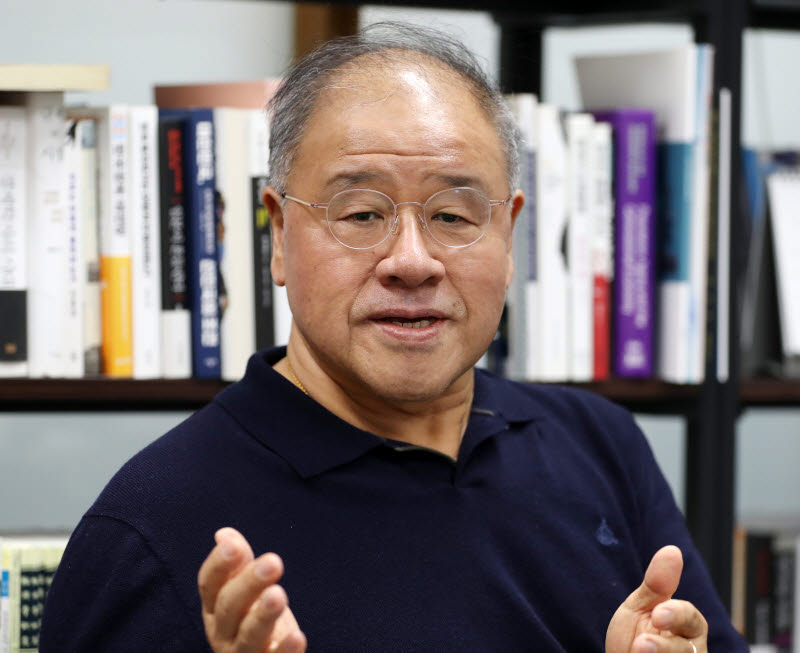 |
| Chong-Bum An, President of the Policy Evaluation Research Institute (PERI) (Photo = Edaily, Reporter Tae-hyung Kim) |
“Foreign Capital Flees by ₩40 Trillion, Retail investors Responded with Leverage”
President An identified the sharp outflow of foreign capital and the subsequently leveraged response of domestic retail investors as the most notable change in Korea‘s financial market the outbreak of the U.S.-Iran war.
“Over roughly a month after the war, foreign investors recorded net sales of around 40 trillion won, and domestic retail investors absorbed nearly all of that volume,” he explained. “Margin balances in the stock market have also climbed to approximately 40 trillion won.” He added, “The alignment of these two figures suggests that a significant portion of retail buying may have been heavily reliant on leverage.”
The concern is that such a structure could become highly vulnerable during a market downturn. “As long as stock prices hold up, the situation may appear manageable. But given the current external environment, downside risks are much greater,” he said. “If retail investors’ losses begin to materialize, combined with burden of rising interest rates, the overall risk could expand significantly.”
Regarding recent volatility in the foreign exchange market, An noted, “When foreign investors continue selling equities and then later shift back to buying, the exchange rate repeatedly falls from the ₩1,500 range to around ₩1,470,” he said “foreign capital enter at higher exchange rate levels, when the dollar is strong, driving up stock prices, and then exit when the exchange rate falls, when the won appreciates, allowing investors to benefit both equity gains and foreign exchange arbitrage profits.
He pointed out, ”This structure is sustained largely due to because domestic retail investors, often referred to as ‘ants’ in Korea, tend to move in tandem with market momentum,“ warning ”If this trend continues, the exchange rate could enter an upward phase while stock prices move into a long-term downward trend, with losses ultimately concentrated among retail investors.“
”Korea‘s Shrinking Fiscal Space… Supplementary Budget Practices Needs to be Re-examined“
The role of fiscal policy will become even more critical as external shocks, such as tensions in the Middle East, can rapidly transmit to the Korean economy. ”Fiscal policy is the last line of defense to absorb financial market shocks,“ Ahn said, ”but the problem is that Korea no longer has sufficient fiscal capacity.“
He also expressed concern about fiscal conditions in the second half of the year. ”Recent excess tax revenues have largely been driven by strong performance in sectors such as semiconductors and automobiles,“ Ahn noted. ”If these are used rather than accumulated as fiscal reserves, we may face severe revenue shortfalls in the latter half of the year, drastically exacerbating fiscal risks.“
He further criticized the structural limitations of Korea’s current supplementary budget process. ”As supplementary budgets financed through excess tax revenues become routine, government spending is increasingly taking priority over debt repayment,“ he warned. ”That runs counter to the core legislative spirit of the National National Finance Act.“
He criticized the habitual methodology of budget formulation: ”The government repeatedly decides the size of supplementary budgets first and then searches for ways to allocate the funds afterward. In this process, inefficiencies arise as ministries rush to create projects simply to absorb the spending.“
He also urged caution regarding cash-based fiscal support policies. ”Universal cash payments have limited effectiveness and may add inflationary pressure,“ he said. ”In the end, lower-income households may suffer the most.“ ”Fiscal policy should be strictly designed to reduce risks,“ he added, ”but under certain conditions, there is a possibility it may instead end up amplifying systemic risk.“
Looking further ahead, President An identified ”demographic aging“ as the single greatest long-term burden on Korea‘s fiscal sustainability. ”Korea is aging at one of the fastest rates in the world, and entering a phase of rapidly increasing National Pension expenditures,“ he explained. ”Beyond pensions, rising healthcare expenditures will also become a major burden,“ he said. ”Unlike the U.S., where defense spending is the primary source of fiscal pressure, Korea’s key fiscal challenges will come from public pensions and healthcare costs.“
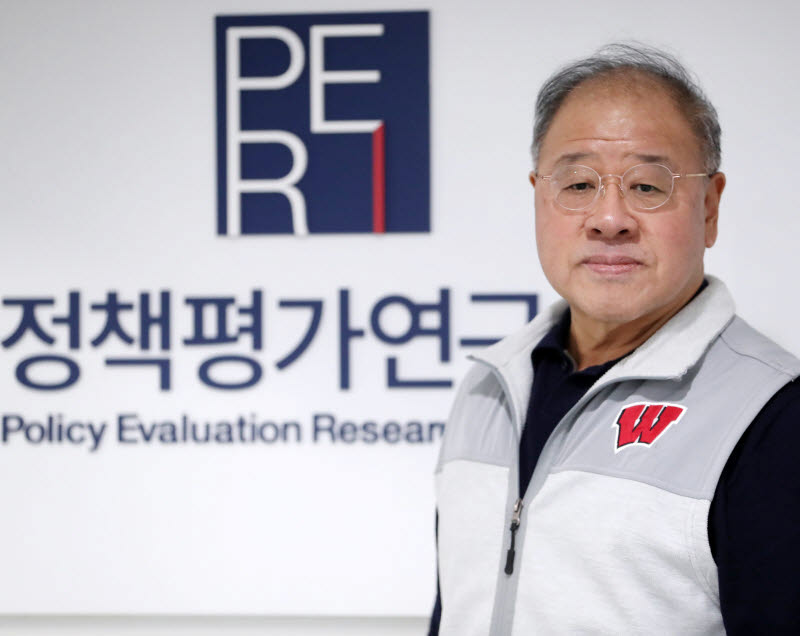 |
| Chong-Bum An, President of the Policy Evaluation Research Institute (PERI) (Photo = Edaily, Reporter Tae-hyung Kim) |
”Weakening Industrial Foundation Leads to Greater Problems… Data-Driven Policymaking Is Essential“
Ahn identified the structural weakening of Korea‘s industrial base as the most critical risk factors facing the national economy. ”Ultimately, the economy is structured around companies producing goods, exporting them, and earning foreign currency.“ He noted, ”When numbers of policies and external factors constrain corporate activities, the overarching growth engine inevitably will be deteriorated.“
He also highlighted that, majority of key industries , with the notable exceptions of semiconductors and automobiles, are currently facing significant challenges. ”Key manufacturing sectors such as steel and petrochemicals are showing signs of instability,“ he stated. ”Furthermore, due to regulatory and tax burdens,, we are increasingly witnessing a trend where corporations actively considering to relocate abroad Korea.“
Regarding future fiscal and monetary policy responses, he stressed the importance of utilizing data. ”Korea is well-positioned to monitor economic conditions in real time through diverse data sources such as credit card transactions and power consumption grids,“ he explained. ”Utilizing such data enables to formulate precise, targeted interventions tailored specifically by industry and geographic region.“
He added, ”Instead of the issuing blanket cash handouts to the lower 70% income bracket, we must implement data-driven filtering to selectively support genuinely vulnerable populations. Technically, this is already fully feasible.“
Furthermore, he pointed out, ”We must systematically establish an Early Warning System (EWS) to proactively detect economic risks in advance and respond proactively. Regrettably, our capacity to utilize such data is not being fully realized.“
These insights will be a central theme at the ”PERI Special Symposium“ at the 17th Edaily Strategy Forum, scheduled to take place on June 16-17 at the Shilla Hotel in Seoul. President An plans to examine the two key pillars of economic policy, taxation and fiscal policy, alongside monetary and financial policy, and present strategic directions on how policy tools should operate in a complex crisis environment. In particular, the symposium is expected to provide a comprehensive perspective on the structural hurdles and future policy directions facing the Korean economy, emphasizing that fiscal and financial measures must go beyond simple counter-cyclical measures to simultaneously secure long-term economic sustainability and a robust growth foundation.
About President An…
△ Ph.D. in Economics, University of Wisconsin-Madison △ Senior Research Fellow, Daewoo Economic Research Institute △ Research Fellow, Korea Institute of Public Finance (KIPF) △ Professor, University of Seoul △ Professor of Economics, Sungkyunkwan University (SKKU) △ President, Korean Association of Public Finance (KAPF) △ Member of the 19th National Assembly △ Senior Presidential Secretary for Economic Affairs & Policy Coordination △ (Current) President, Policy Evaluation Research Institute (PERI)
![[크레딧 체크포인트]돈은 잘 버는데…SKB, 퍼주기 배당에 발목](https://image.edaily.co.kr/images/Photo/files/NP/S/2026/06/PS26060101137.670x.0.jpg)
![법정 간 키이스트 딜…이로투자, SM엔터에 계약금 반환 소송[only 이데일리]](https://image.edaily.co.kr/images/Photo/files/NP/S/2026/06/PS26060101054.800x.0.jpg)
![올해 350조원 벌 삼전에 생산적금융 5000억원 대출 필요할까[현장에서]](https://image.edaily.co.kr/images/Photo/files/NP/S/2026/06/PS26060101039.jpg)

![[기자수첩]총량 규제의 그림자…좁아진 금리인하 통로](https://image.edaily.co.kr/images/Photo/files/NP/S/2026/06/PS26060100939.jpg)



![[전화성의 기술창업 Targeting] 〈395〉 [AC협회장 주간록105] 마이클 잭슨 자산과 스타트업 경영](https://img.etnews.com/news/article/2026/05/04/news-p.v1.20260504.773e529e3f474adea55b425cf6daf8c2_P3.jpg)
!['통한의 극장골 실점 패배' 주승진 김천 감독 "뒷심이 부족했다" [전주 현장]](https://image.starnewskorea.com/21/2026/05/2026051714010261496_1.jpg)


 English (US) ·