
 2 hours ago
2
2 hours ago
2
[Main Title]
“Korea‘s Fiscal Policy Is Being Overshadowed by Excessive Politics… We Need Data-Driven Policymaking” [ESF 2026]
[Sub-Title]
Day 2 of the 17th Edaily Strategy Forum
Chong-Bum An President, The Policy Evaluation Research Institute (PERI)
“Fiscal and Monetary Policy Could Conversely Increase Policy Risk”
Calls for Evidence-based Policymaking through Greater Use of Data, Indices, and Statistics.
[Edaily By Reporter Ha-yeon Shin] Chong-Bum An President, The Policy Evaluation Research Institute (PERI), stressed that “Tax and fiscal policies, alongside monetary and financial policies, must be designed based on data and evidence.” He pointed out that while fiscal and monetary policies are key tools for responding to crises, they can also become policy risks that worsen crises depending on how they are implemented.
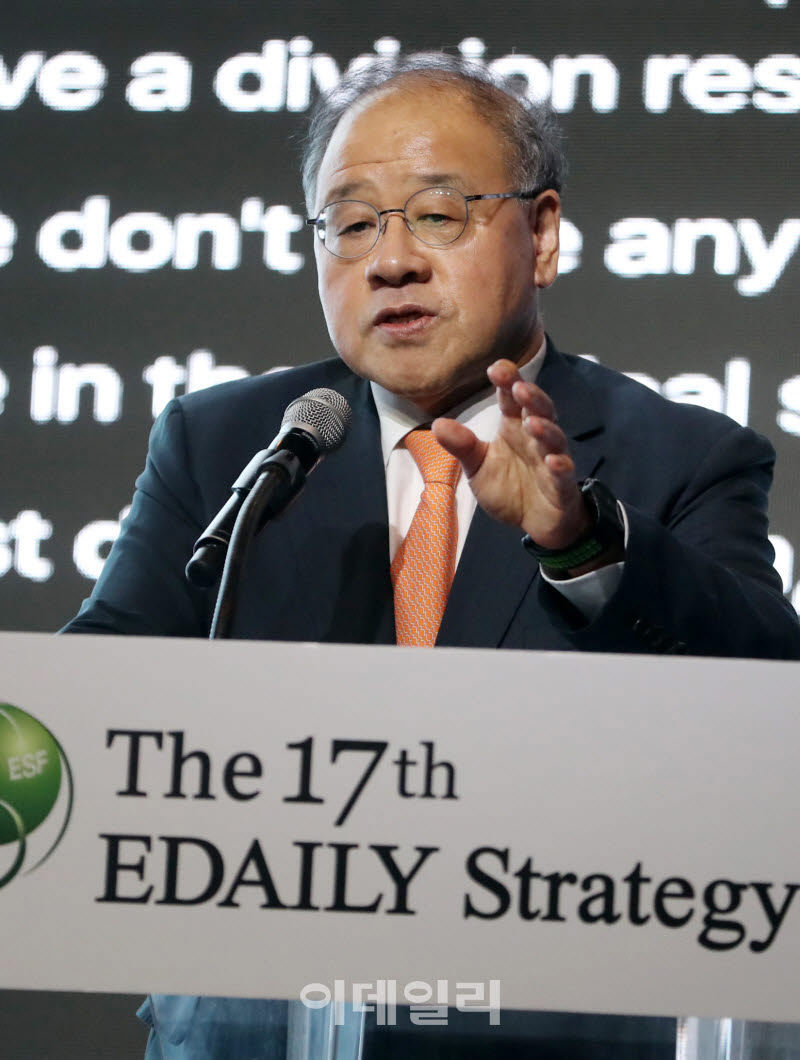 |
| At the 17th Edaily Strategy Forum, held on the 17th at The Shilla Seoul in Jung-gu, Seoul under the theme “The Age of Power, Recasting Civilization : Who Designs the New World?”, President Ahn Jong-beom of the Policy Evaluation Research Institute (PERI) delivered opening remarks before the Edaily-PERI special symposium during the second day of the event. (Photo = Tae-hyung Kim, Edaily Reporter) |
In his opening remarks at the Edaily-PERI Special Symposium during the 17th Edaily Strategy Forum, President Ahn stated, “In Korea these days, policies are being significantly buried under excessive politics.” He added, “Fiscal policy and monetary policy are the most important policy tools in economic security, and the core of it. These two policies are key to managing and responding to crises, but now they are in a dangerous situation where they could instead intensify crises.”
He then emphasized the importance of evidence-based policy evaluation. “The U.S. passed the Evidence-Based Policymaking Act and has continued to implement it ever since,” explaining, “The key principle is is that every policy must always be supported by data.”
Conversely, he pointed out, “In Korea, policies are made overnight in the political circles, and yet another policy is crafted without any ex-post evaluation.” Taking population policy as an example, he noted, “While conducting population forums with Edaily over the past 2 years, we examined Korea’s population policies numerous times with leading international scholars, but many concluded that it is difficult to even evaluate their effectiveness.”
He also mentioned the diversification of national debt indicators as an example. President Ahn stated, “There was once considerable debate among politicians, the media, and academics over how national debt should be measured,” He added, “I suggested that fiscal statistics be published under multiple categories, such as D1, D2, D3, and D4 depending on their scope, to help avoid unnecessary controversy.”
He re-emphasized, “For evidence-based policy, we need data, we need indices, and we must make extensive use of statistics,” and concluded, “Through index development, evidence-based policy can become much more accessible to the public.”





!["Sustainability Should be Ensured through Data-Driven Fiscal and Monetary Policy” [ESF2026]](https://image.edaily.co.kr/images/Photo/files/NP/S/2026/07/PS26070900460.jpg)

![[속보] 北, 韓·EU성명에 “체제존중 위장 내던져…韓 적대 원칙 불변”](https://pimg.mk.co.kr/news/cms/202606/13/news-p.v1.20260613.89255ddca2b0487c98e7f979e85a8a39_R.jpg)





 English (US) ·